


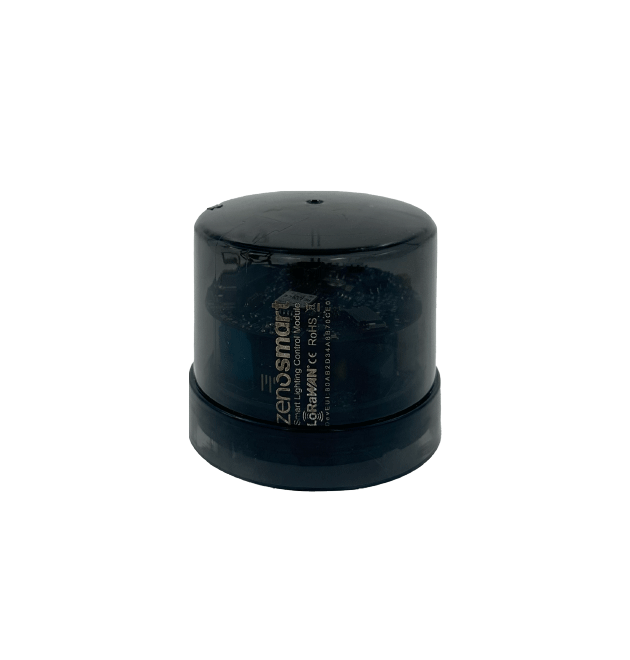
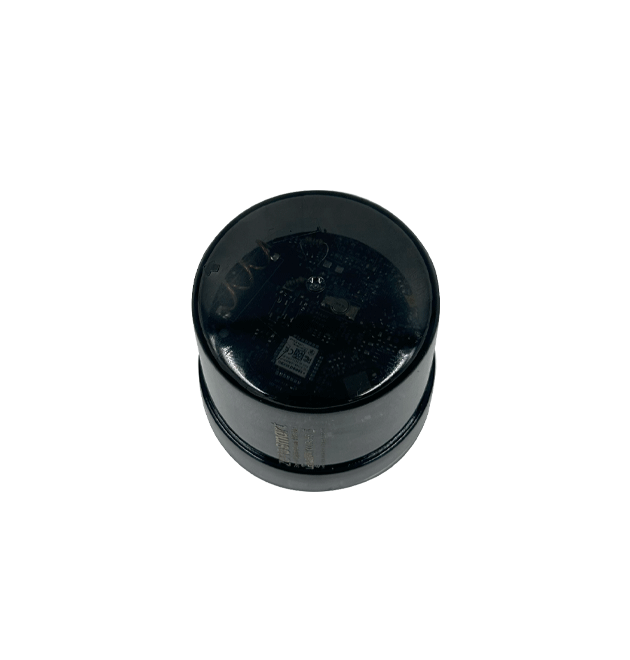
| Category | Parameter | Specification |
|---|---|---|
| Power Supply | Power source | 100–240 VAC 0.2 A (up to 15 A nominal load) |
| Power Supply | Max. power consumption | 3 W (Maximum) |
| Power Supply | Surge protection | Built-in surge protection circuit |
| Power Supply | Overcurrent protection | Built-in overcurrent protection (auto reset) |
| Communication | Network interface | LoRaWAN® 1.0.4 Class C / NB-IoT (3GPP LTE Release 14 Cat-NB1 & Cat-NB2 compliant) |
| Communication | RF frequency | 868 / 915 / 923 MHz (LoRaWAN) / B3, B8, B20 (1710–1880, 880–960, 791–862 MHz) |
| Communication | Receiver sensitivity | -137 dBm @ 125 kHz BW SF12 (LoRaWAN) / -108 dBm (Cat-M1 low band), -107 dBm (mid band) |
| Communication | Transmit power | Up to +22 dBm (LoRaWAN, region dependent) / up to +23 dBm (NB-IoT) |
| Communication | Network security | Secure communication with AES-128 encryption / APN, VPN support |
| Communication | GPS | GPS/GLONASS/BeiDou/QZSS |
| Communication | OTA update | Via Bluetooth and LoRaWAN® |
| Communication | Bluetooth | Supported (Optional) |
| Interfaces | DALI control & power | Controls up to 4 DALI ballasts with built-in 15V DC power supply |
| Interfaces | Analog output | 0–10 V or 1–10 V analog output |
| Interfaces | Logical input (LSI) | 1 × 0–24V configurable logic input (analog/digital), dim levels, etc. |
| Sensors | Light sensor | Integrated, threshold adjustable |
| Sensors | Tilt sensor | 2-axis tilt sensor |
| Lamp Control | Dimming range | 0–100% (linear/logarithmic depending on configuration) |
| Lamp Control | Control interface | DALI-2 / DiiA (IEC 62386) / D4i / 0–10 V / 1–10 V analog |
| Measurements | Internal parameters (non-D4i drivers) | A, V, W, Wh, WB, Wfund, PF, lamp-on time, sag, swell |
| Measurements | D4i reported parameters | V, W, Wh, PF, lamp-on time and others (depending on control gear capabilities) |
| Measurements | Measurement accuracy | ±0.5% (for internal measurement circuitry) |
| Output Switch | Mechanical relay | 5A (100,000 operations) |
| Output Switch | Solid-state relay | 2A (with zero-cross detection) |
| Output Switch | No switching | No output available |
| Timing | Real-Time Clock (RTC) | Yes, supercapacitor backup (up to 15 days) |
| Environmental | Ingress protection | IP66 (IEC 60529) |
| Environmental | Operating temperature | -20 °C … +60 °C |
| Mechanical | Standard | ANSI C136.41 2013 |
| Mechanical | Pin & positions | 5 or 7 pins & 3-pin power connection; 2 or 4-pin dimming and signal connection |
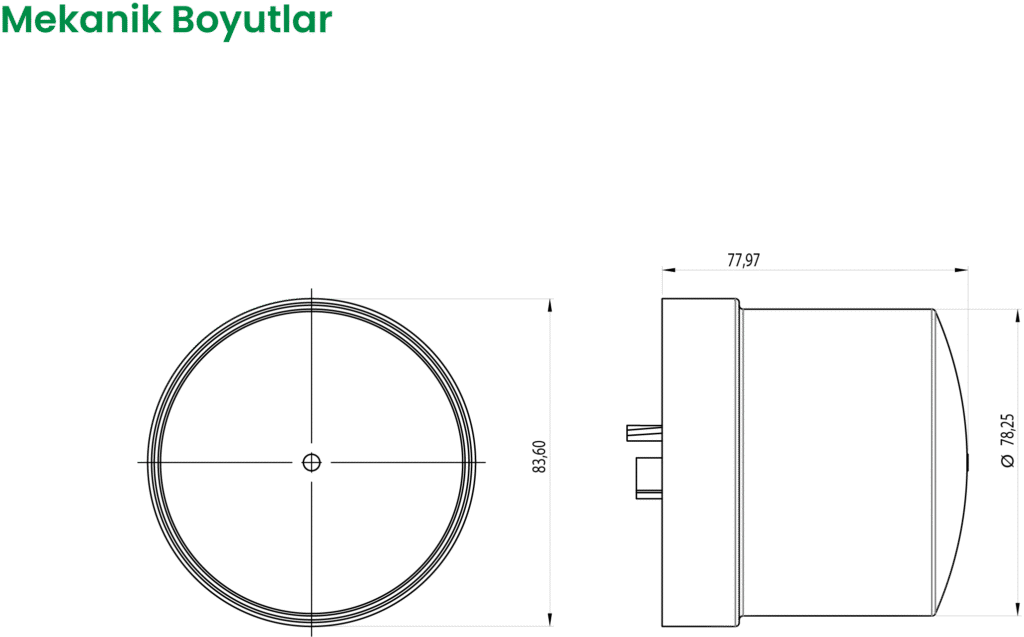
| Mechanical | Weight & dimensions | 150 g / Ø 76 mm × 70 mm (height × diameter) |
| Mechanical | Base & dome material | High-temperature resistant PBT & UV-protected, impact-resistant polycarbonate |
| Compliance | Standards | EN 61347-1, EN 61347-2-11, EN 300220, EN 62368, EN 301489, EN 62479, EN 50581 |
| Compliance | Certifications | CE |
| NEMA ANSI C136.41 5/7-Pin LoRaWAN® Lighting Controller Unit | Download |
1. Which network protocols does the LoRaWAN® Luminaire Controller NEMA device support?
The device supports LoRaWAN® 1.0.4 Class C, NB-IoT (Cat-NB1 and Cat-NB2 compliant), and LTE-M low-power wide-area network (LPWAN) technologies. This enables secure and efficient management from both field and cloud-based platforms.
2. What are the lighting control and dimming capabilities of the device?
The controller provides precise dimming through DALI / DALI-2 / 0–10 V / 1–10 V interfaces. The dimming range can be adjusted between 0–100% and configured as linear or logarithmic. It can also operate autonomously based on the integrated light sensor and predefined scheduling scenarios.
3. How durable is the device and what environmental protection does it offer?
The device housing features IP66 / IP67 protection, made from high-temperature-resistant PBT and UV-protected polycarbonate materials. It operates in a temperature range of –20 °C to +60 °C and is built to withstand harsh environmental conditions.